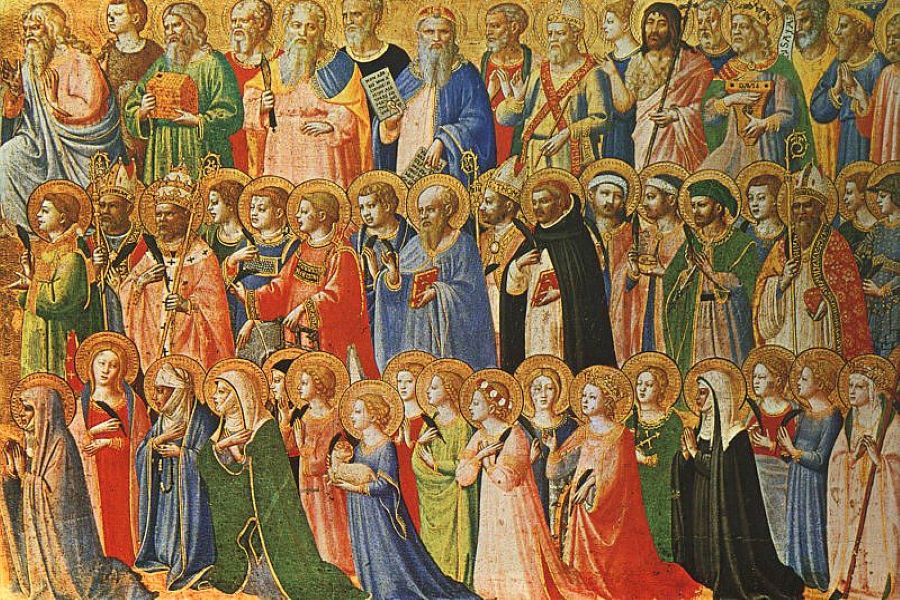
The Communion of Saints
by Jen Arnold, M.A. | 11/01/2026 | Weekly ReflectionThe Church’s devotional and liturgical traditions have long designated November as the “Month for Holy Souls,” with November 1st as All Saints’ Day and November 2nd as All Souls’ Day. The Church places these two feast days back-to-back to emphasize the three states of the Church within the communion of saints. The communion of saints includes all members of the Mystical Body of Christ, regardless of their state. Through the communion of saints, we find our hope in what awaits us after death. This doctrine, which we profess in the Apostles’ Creed, is rooted in Scripture. St. Paul describes the spiritual reality around us, saying, “Therefore since we are surrounded by so great a cloud of witnesses…” (Heb 12:1), and Jesus explains that death is not the end when he says, “I am the resurrection and the life; he who believes in me, though he die, yet shall he live…” (Jn 11:25-26). In a culture marked by social isolation and fear of pain, suffering, and death, these two feast days remind us that we are not alone.
According to the Church, the communion of saints is the Church (cf. CCC 946). “The term ‘communion of saints’ has two closely linked meanings: communion ‘in holy things (sancta)’ and ‘among holy persons (sancti)’” (CCC 948). This means that all the graces and goods Christ offers to the members of his body (sancti) are communicated through the sacraments (sancta) (cf. CCC 947). The Church is not a building or a stagnant organization but the living, active Mystical Body of Christ, animated by grace.
Each member of the body of Christ lives in one of three states: the Church militant, the Church suffering, or the Church triumphant. The militant state refers to those of us here on earth, still battling sin and temptation as we participate in the work necessary for our salvation. The suffering state refers to the souls of the faithful departed in purgatory, undergoing purification. While the purification process is painful, purgatory is not a place of despair but the final preparation of souls who died in the state of God’s grace. The souls in this state are assured of salvation yet need final purification “so as to achieve the holiness necessary to enter the joy of heaven” (CCC 1030-1031). Souls in the triumphant state are already in heaven, beholding the beatific vision that enables them to contemplate the Triune God as he is. The three states do not indicate that the Church is divided or that there are three disconnected Churches. Rather, the states remain a united body, “reinforced by an exchange of spiritual goods” (CCC 955). The Second Vatican Council describes the three states and their shared unity in the Dogmatic Constitution of the Church: “some of His disciples are exiles on earth, some having died are purified, and others are in glory beholding ‘clearly God Himself triune and one, as He is’; but all in various ways and degrees are in communion in the same charity of God and neighbor and all sing the same hymn of glory to our God” (Lumen Gentium 49).
As an aside, while the Church celebrates and honors formally canonized saints, most saints in heaven are souls whose names we’ll never know until we arrive there. These saints lived ordinary lives of faith and fidelity to Christ. All Saints’ Day offers us the opportunity to honor all the souls in heaven, whether canonized or not, and to recognize the hidden holiness of daily life.
Together, the three states interact through a living exchange of spiritual goods. The souls in purgatory and those in heaven “do not cease to intercede with the Father for us” LG 49; cf. CCC 956–958) Through the one Mediator, Christ Jesus, they offer their merits on our behalf. Just as we ask our friends to pray for us on earth, we can continue to ask for their prayers after death, since they remain part of the living Church. In her final months battling tuberculosis, St. Thérèse of Lisieux promised, “I’ll spend my heaven doing good on earth.” Similarly, the souls in the Church triumphant and those of us still in the Church militant, intercede for the souls in the Church suffering. From the earliest days, the Church has prayed for the faithful departed. “Rest in peace” (requiescat in pace) is a prayer, asking God to permit a person’s soul to enter eternal peace in heaven. The Old Testament refers to praying for the dead: “But if he was looking to the splendid reward that is laid up for those who fall asleep in godliness, it was a holy and pious thought. Therefore, he made atonement for the dead, that they might be delivered from their sin” (2Mac 12:45-46). Our prayers, especially in the Liturgy of the Eucharist, help them and, in turn, make their intercession for us more effective. This mutual charity among members and across the states of one body is our participation in the life of the Risen Christ.
The saints in heaven and the souls in purgatory also teach us about hope. Jesus revealed to Martha, “I am the resurrection and the life; he who believes in me, though he die, yet shall he live, and whoever lives and believes in me shall never die” (Jn 11:25-26). The saints, who lived as followers of Jesus on earth, show us what we may look forward to if we do the same. Souls in purgatory have hope as they are prepared for the glory to come, and this gives us hope that, if we die in a state of grace, we have nothing to fear. Both states are therefore living signs of the promise Jesus made to Martha. This hope ought to transform how we face our own mortality, without fear. It should also shape how we endure suffering and loss, offering our pain for the souls in purgatory. Prayers and sacrifices for the dead are acts of charity that help us remain connected to other members of the Body after death. To the world, hope is optimism, but for us it is the theological virtue that trusts in God's fidelity, who raised Jesus and promised the same for us (cf. CCC 1817).
November is a good time to reorient our priorities. All Saints’ Day reminds us of the goal we strive for, while All Souls’ Day reminds us of the purification needed to reach it. We can live as members of this great family now so that we may later join our loved ones among the multitude of saints in heaven. We can participate in the communion of saints in practical ways in daily life. For example, in our daily trials and difficulties, we can invoke the saints, especially the patron saints of our states in life or of a particular problem. We can offer Masses, indulgences, almsgiving, suffering, and personal sacrifices for the holy souls, especially in November. Finally, we can cultivate an awareness that every act of faith and every hidden suffering offered in love benefits the whole Body. How will you honor the saints and the holy souls this November?