Corpus Christi Blog
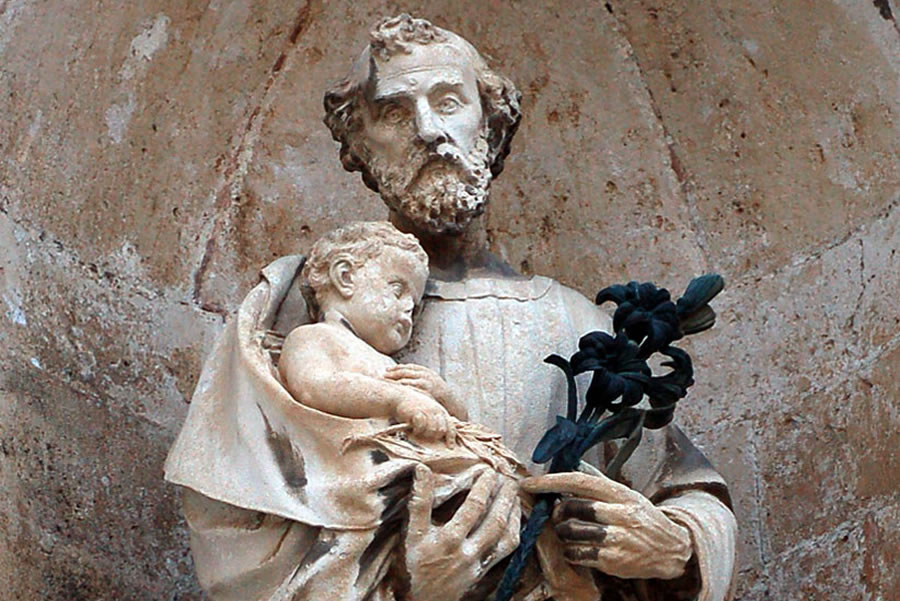
St. Joseph and the Eucharist
10-18-2026Weekly ReflectionJen Arnold, M.A.One of the Church’s most beloved saints is St. Joseph. He is honored and revered for his role as the head of the Holy Family and guardian of Jesus. The litany of St. Joseph asks for his intercession under his various titles such as Protector of the Holy Church, Light of Patriarchs, and Guardian of the Redeemer. In his book, Saint Joseph: The Man Closest to Christ, Fr. Sebastian Walshe, O. Praem., asserts that St. Joseph is also the Guardian and Provider of the Eucharist. His premise is that because St. Joseph was entrusted with the care of Christ’s physical body on earth, he continues to exercise unique guardianship and care over Christ’s sacramental body in the Eucharist from heaven. Fr. Walshe reaches this conclusion through two foundations – typology and theology, which I will explain here.
READ MORE
Our Sunday Obligation
10-11-2026Weekly ReflectionJen Arnold, M.A.For all baptized Catholics, Sunday Mass is not optional, but an obligation. Sunday is the day on which Jesus Christ rose from the dead and is therefore worthy of weekly celebration. Since the earliest days of the Church, beginning with the Apostles, Christians gathered on the first day of the week to celebrate the Resurrection and the Eucharist. These gatherings very quickly became a solemn obligation of faith. The requirement is rooted in the third commandment to “keep holy the Sabbath” by remembering Christ’s Passion, Resurrection, and glory and giving God the thanks, praise, and worship he is due. While the obligation to attend Sunday Mass is serious, it should not be perceived as burdensome and legalistic. We ought to approach Mass with love for God and view it as a gift. We are privileged to freely accept God’s invitation to gather where Christ encounters the faithful, nourishes us with his body, and unites us in faith and charity.
READ MORE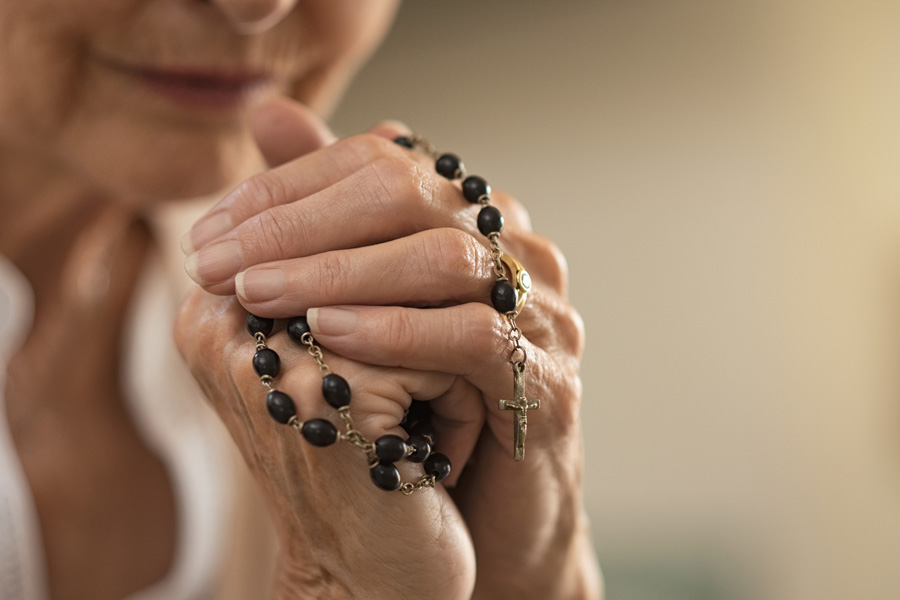
Pray the Rosary
10-04-2026Weekly ReflectionJen Arnold, M.A.The month of October is dedicated to the Holy Rosary of the Blessed Virgin Mary, with the feast of Our Lady of the Rosary falling on October 7. Following the Christian naval victory over the Ottoman fleet at the Battle of Lepanto on October 7, 1571—a victory attributed to Mary’s intercession amid widespread prayer of the Rosary—Pope Saint Pius V established the feast of Our Lady of Victory. In 1573, Pope Gregory XIII changed its title to the Feast of Our Lady of the Rosary. Pope Clement XI thenextended the celebration to the universal Church in 1716, and Pope Saint Pius X fixed its date as October 7 in 1913. The entire month of October was dedicated to the Holy Rosary by Pope Leo XIII in his 1883 encyclical Supremi Apostolatus Officio (The Supreme Apostolic Office).
READ MORE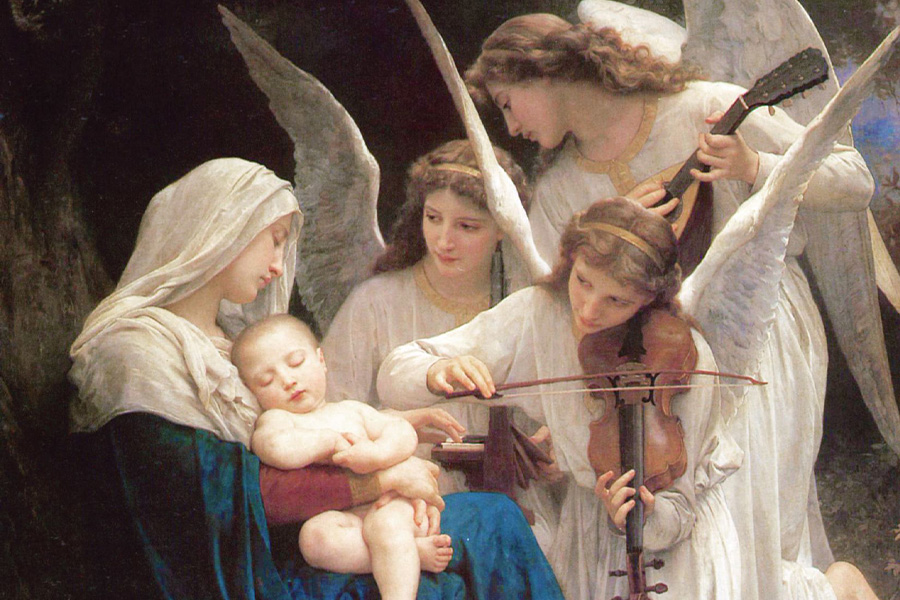
The Choirs of Angels
09-27-2026Weekly ReflectionJen Arnold, M.A.You might not think too much about it, but you are likely aware that we are surrounded by invisible beings called angels. Let’s look at what angels are and what their role is in our lives and our salvation.
Angels are purely spiritual beings without bodies that still possess intelligence and will. Despite not having a body, each angel is considered an individual just like you or me. Angels were created prior to humanity and are higher than humans in the hierarchy of creation. They are more beautiful, glorious, and perfect than any visible creation (CCC #330).
READ MORE
The Significance of the Stigmata
09-20-2026Weekly ReflectionJen Arnold, M.A.Later this week, on September 23rd, the Church celebrates the memorial of St. Padre Pio, a saint celebrated for his extraordinary spiritual gifts. St. Pio (1887-1968) was an Italian Capuchin friar known for his mysticism, healing abilities, miraculous bilocation, and the ability to read souls during confession. Perhaps the spiritual gift for which St. Pio is most revered is that of bearing the stigmata — the visible bleeding wounds of Christ’s crucifixion — that we will learn about today. Let’s explore the definition of stigmata, what they mean within the Catholic tradition, and how the Church approaches claims of stigmata, ending with a few other stigmatists who have been recognized and honored by the Church.
READ MORE
A Glimpse Inside the Cloistered Life
09-13-2026Weekly ReflectionJen Arnold, M.A.When it comes to picturing ways of serving the Church, many people likely think of priests celebrating Mass, missionary work, teaching and catechizing, or volunteers feeding the poor. These are all visible works of charity that are critical to the Church’s mission. Similarly, when we think of religious vocations, we tend to picture religious orders with which we are most familiar, given their visible activity in the world. Our diocesan priests dispense the sacraments every day, the Sisters of Charity tend to the poor and marginalized, the Fathers of Mercy come to our parishes for our Advent and Lenten missions, and so on. Again, these visibly active religious orders are a necessary and life-giving part of our Church’s mission. Still, there is another hidden type of religious community that offers a form of service just as essential to the life of the Church, even if few people ever witness it — cloistered religious orders.
READ MORE
Christ at the Center — Many Called to Serve
09-06-2026Weekly ReflectionMatt Henry, Director of Music & LiturgyWhen we celebrate the Mass, Christ is at the center, the priest presides, and many parishioners contribute their gifts to the sacred liturgy. Beyond the ordinary ministers (the priest and deacon) many other people help enhance the beauty and reverence of the Mass week in and week out. Some of them we can see and hear, while others work behind the scenes. All of them help make Corpus Christi a welcoming place where we can grow in our faith and develop a deep, personal, lifelong relationship with Jesus.
READ MORE